Products / Frosted Glass
Frosted Glass
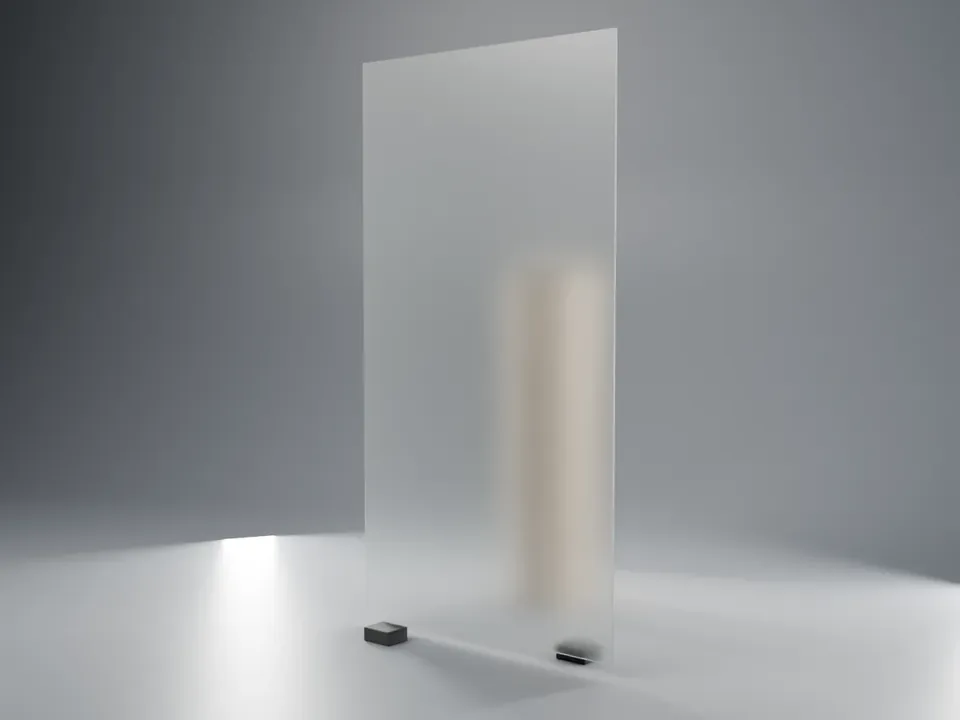
Frosted glass has a translucent, matt surface that diffuses light and obscures direct view through the glass. It is used where daylight is wanted but clear visibility is not, such as office partitions, doors, bathroom windows and shower enclosures.
Product Overview
The frosted effect comes from a finely roughened surface on one face of the glass. The roughened surface scatters light instead of letting it pass straight through, so shapes behind the glass appear softened while the space on both sides stays lit.
Frosted glass differs from tinted glass, which changes colour and light transmission but remains transparent, and from designer frosted glass, where only selected areas are frosted to form a pattern.
How Frosted Glass Is Produced
Two common methods
- Sandblasting — Fine abrasive is blasted against the glass surface to roughen it. The finish can be applied to the whole pane, or to selected areas using a mask.
- Acid etching — The glass surface is treated with acid in a controlled factory process, giving a smooth, even satin finish. Acid-etched glass is usually produced by glass manufacturers as sheet stock.
The two finishes differ in texture, appearance and handling. Compare samples before specifying.
What RARA does
RARA’s processing includes sandblasting and frosting. Acid-etched glass, where a project calls for it, is a manufacturer-produced finish; confirm the required finish with our team when requesting a quotation.
Characteristics
- Privacy — Obscures direct view. The degree of obscuration depends on the finish, lighting conditions and how close objects are to the glass.
- Light — Transmits diffused daylight.
- Surface — Matt finish on the treated face; the other face remains smooth.
- Wet surfaces — Water on the frosted face can temporarily reduce obscuration. In shower areas the frosted face is often placed on the dry side.
- Maintenance — Sandblasted surfaces can show fingerprints and grease marks more readily than smooth glass. Clean with non-abrasive products.
- Further processing — Frosted glass can be toughened. Agree the processing sequence with our team for toughened frosted panels.
Applications
- Office partitions and meeting rooms — Privacy with shared daylight between rooms.
- Doors and door panels — Obscured vision panels in interior and bathroom doors.
- Bathroom windows and shower enclosures — Privacy where natural light is still needed.
- Glass railings — Where a solid-looking but light-transmitting barrier infill is preferred.
- Interior screens and residential interiors — Dividing space without blocking light.
Specification Considerations
Information to have ready when requesting a quotation:
- Area to be frosted: full pane, band or partial area
- Which face is to be frosted
- Finish required: sandblasted or acid-etched
- Dimensions and glass thickness
- Whether the panel is to be toughened
- Edge finish, holes and cut-outs
- Application, including wet or dry location
- Quantity
RARA Processing and Supply
Processes relevant to frosted glass from RARA’s processing capability:
- Sandblasting
- Frosting
- Toughening
- CNC glass cutting
- Edge polishing
- Drilling, cut-outs and notches
- Installation of office partitions, glass doors and shower enclosures
Related Products
- Designer Frosted Glass — where only selected areas are frosted to form a pattern or logo
- Toughened Glass — for frosted panels in doors, partitions and shower enclosures
- Digital Printed Glass — where a design needs colour rather than a frosted finish
Product images on this page are computer-generated illustrations for reference. They are not photographs of RARA projects, facilities or installations.
Discuss Your Frosted Glass Requirement
Share your project dimensions, quantity and application requirements with our team. RARA can review the specification and discuss the appropriate glass solution.